The instruments in the room
The Portuguese guitar in fado
What the pear-shaped Portuguese guitar is, how it differs from the viola beside it and the guitars of Lisbon and Coimbra, and what to listen for.
Reserve a place for the fado hour ↗Quick answer
A fado singer is traditionally accompanied by two guitars: the guitarra portuguesa, a pear-shaped instrument with twelve steel strings that gives fado its bright, metallic ring, and the viola, a wire-strung acoustic guitar that plays beneath it. Together they carry the song while the voice carries the words, and the Portuguese guitar comes in a Lisbon and a Coimbra form.
Two instruments, two jobs
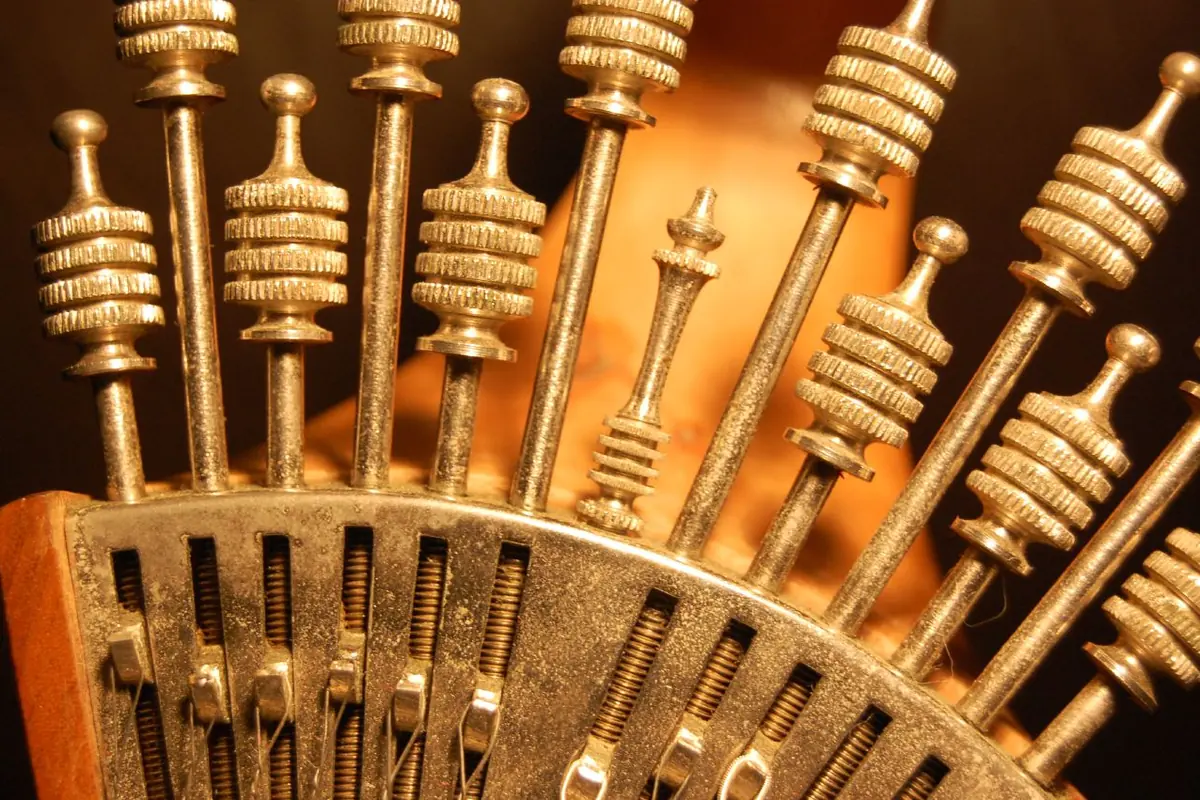
UNESCO's entry pictures a solo singer with two instruments, a steel-strung acoustic guitar and the guitarra portuguesa. A little attention is enough to tell the two apart. Taste of Lisboa writes that the Portuguese guitar's bright, metallic sound and intricate ornamentation became the defining sound of fado, so the ringing, decorated lines belong to that instrument, and the guitar sits beneath it.
The Portuguese guitar
UNESCO calls the guitarra a cittern shaped like a pear, with twelve wire strings and a design found only in Portugal; it also has a long solo repertoire. Wikipedia adds that the twelve steel strings are strung in six courses of two, and that it is one of the few instruments still using watch-key tuners, the metal pegs in the photograph above. Its sound is the bright, metallic ring most people associate with fado. Wikipedia says it is iconically linked with the genre.
Where it comes from
Wikipedia traces the Portuguese guitar to the medieval citole, with evidence of its use in Portugal since the thirteenth century. Later citterns reached Portugal, including the English guitar of the eighteenth century, whose influence can still be seen in the watch-key tuning system, size and stringing. From the middle of the nineteenth century the Portuguese guitar became fashionable through its link with fado accompaniment. The Museu do Fado says the instrument was progressively defined, in the last quarter of that century, as the companion of fado.
The viola
The viola, or viola de fado, is the steel-strung classical guitar that shares the accompaniment. Wikipedia says the Portuguese guitar and this guitar share the work, with an occasional double bass or bass guitar. UNESCO notes that in recent decades the accompaniment has expanded to two Portuguese guitars, a guitar and a bass guitar. So a small room might have one of each, and a larger concert might have more.
Lisbon and Coimbra
There are two main varieties of fado, tied to Lisbon and to Coimbra, and two models of the guitar. Wikipedia says the Lisboa model has a broader soundboard and a scroll ornament shaped like a snail, a caracol, on the tuning machine, while the Coimbra model has a teardrop motif, a lágrima, and a simpler construction. The Coimbra guitar has its own tuning, sound and construction, according to Wikipedia. Coimbra fado is linked to the university and traditionally sung by men. The style heard in Alfama is Lisbon fado.
Not only an accompanist
The guitarra also plays alone. UNESCO says it has an extensive solo repertoire, and Wikipedia names solo pieces for it, called guitarradas. Wikipedia adds that Carlos Paredes, whose father Artur Paredes reshaped the Coimbra tuning, made the Portuguese guitar an instrument known around the world. The Museu do Fado runs a course on Portuguese guitar and one on its construction, a sign of how seriously the instrument is kept alive. In a fado show, listen for the moments when the guitar steps forward between verses.
How to listen in the room
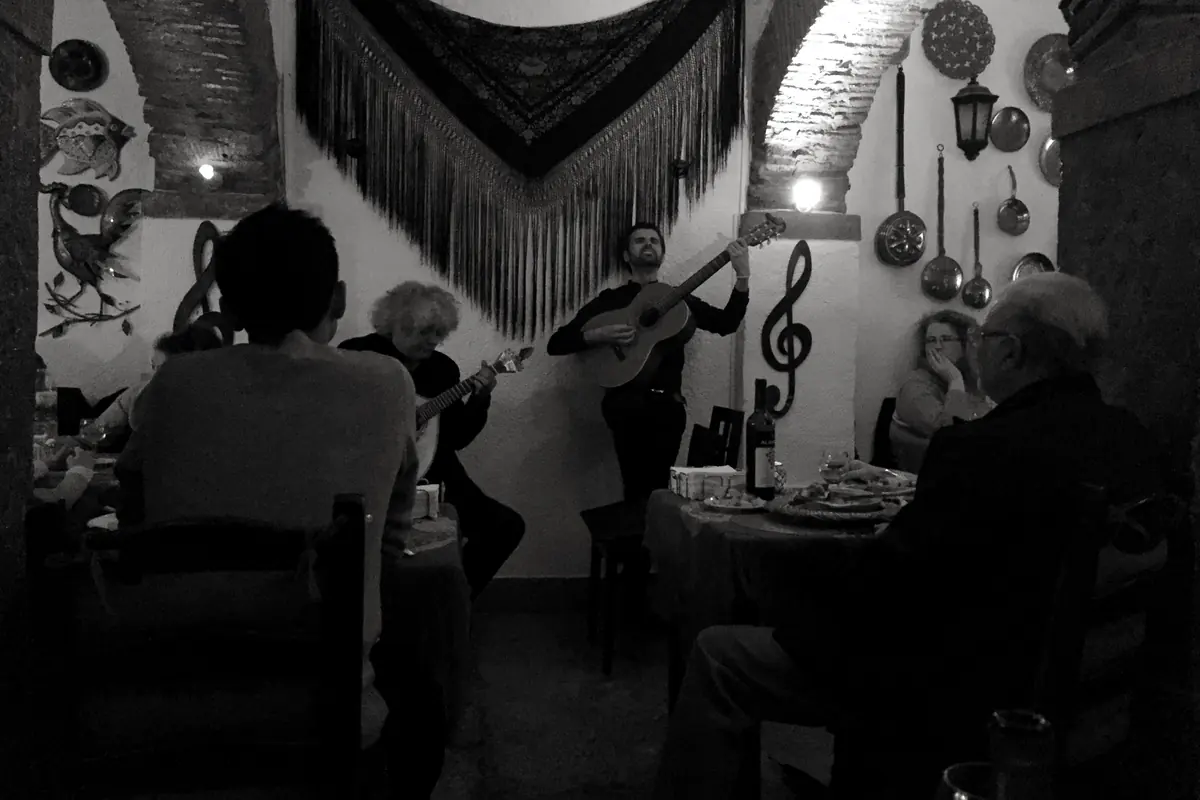
Listen for the contrast between the bright, ornamented Portuguese guitar and the guitar beneath it. Then listen for the pauses. Wikipedia notes that fado music pauses at the end of a phrase while the singer holds the note, and those are the moments when a quiet room matters most, because nothing competes with the voice and the strings. That is a practical reason for the rule of silence, beyond custom.
Read next: Casa Lundum Alfama: what to expect
Who this isn't for
If you only want the singing, you can ignore the instruments. This guide is for listeners who like to know what they are hearing. It will not teach you to play, and it does not tell you what the performers at Casa Lundum will use on the day, because the line-up is the performers' choice. Treat it as a map for listening, with the two instruments above as the usual pair.
Frequently asked questions
What is the difference between the guitarra and the viola?
The guitarra portuguesa is a pear-shaped instrument with twelve steel strings and a bright ring. The viola is a steel-strung classical guitar that plays the chords and rhythm.
Why is the Portuguese guitar tuned with pegs like a watch key?
It is a rare survivor: Wikipedia says few instruments still use watch-key tuners, a feature inherited from the English guitar of the eighteenth century.
Will I hear both instruments at Casa Lundum?
That depends on the performers on the day. The traditional accompaniment is a Portuguese guitar and a guitar, but the line-up is theirs to choose.
Sources